Research
From biochar to self-sensing concrete
Three research teams organized around new-material development, application, and analysis connect biochar-graphene synthesis, conductive concrete, structural-member application, and self-sensing with finite-element analysis into one continuous flow.
Required performance
Three required-performance axes
- 01 Eco-Friendly
Carbon sequestration
Efficient biochar-graphene production, maximized carbon sequestration, and conductivity evaluation.
- 02 High Performance
Conductivity and self-sensing
Damage detection developed and evaluated by imparting conductivity and establishing self-sensing technology.
- 03 Sustainability
Continuous structural monitoring
Real-time damage detection and maintenance through structural performance and conductive-sensor monitoring.
Research teams
Three research teams and their objectives
- Team 1 Won-Chang Choi and Chan Ho Park (early-career)
Biochar-graphene composites for carbon-sequestering cement composites, with materials performance evaluation
Biochar is converted into graphene-based new materials to synthesize cement composites with high conductivity and high carbon content. The composites are characterized, and their mechanical performance, durability, and economy are evaluated.
Objectives
- Biochar-graphene core-shell synthesis: graphitization (600-1100 C, laser, plasma) and catalytic processing (FeCl3, ionic liquids, graphene oxide)
- High-performance cement composites via particle surface modification and hydrophobic polymer binders
- Composition analysis (SEM, SEM-EDX, PSD) and structural analysis (XRD, FT-IR)
- Mechanical performance: compressive and flexural strength
- Durability: drying shrinkage and cracking, freeze-thaw, carbonation, chloride resistance
- Scale-up process optimization and life-cycle environmental-economic analysis (LCA)
- Team 2 Won-Chang Choi and Seung-Wook Seok (early-career)
Self-sensing performance of conductive carbon-sequestering concrete and its application
Conductive cement-composite sensors are developed, and changes in electrical resistance under strain and damage are analyzed. A finite-element material model based on concrete damaged plasticity quantifies the sensing performance.
Objectives
- Optimal sensor mix design and sensing performance via electrochemical impedance spectroscopy (EIS)
- Electrical resistance under strain sensing and moisture content
- Materials performance under multiaxial loading (uniaxial, biaxial, triaxial compression, direct and split tension)
- Finite-element material model for carbon-sequestering concrete based on concrete damaged plasticity (CDP), with validation
- Damage quantification through embedded and surface-mounted sensors, with correlation established
- Team 3 Soo-Yeon Seo and Seung-Wook Seok (early-career)
Application of conductive carbon-sequestering concrete to structural members, with analysis methods
Carbon-sequestering concrete is applied to RC members for structural performance evaluation, with long-term behavior and multi-sensing monitoring. The rebar-concrete interface is modeled to develop a finite-element analysis method for RC members.
Objectives
- Rebar development performance and pull-out behavior under confinement conditions
- Flexural and shear strength of RC members, with evaluation of design-equation applicability
- RC member behavior monitoring through multi-sensing with acoustic emission (AE)
- Modeling methods for rebar and the rebar-concrete interface
- Finite-element analysis method to reproduce the long-term behavior of RC members
Process overview
From biochar to cement composite
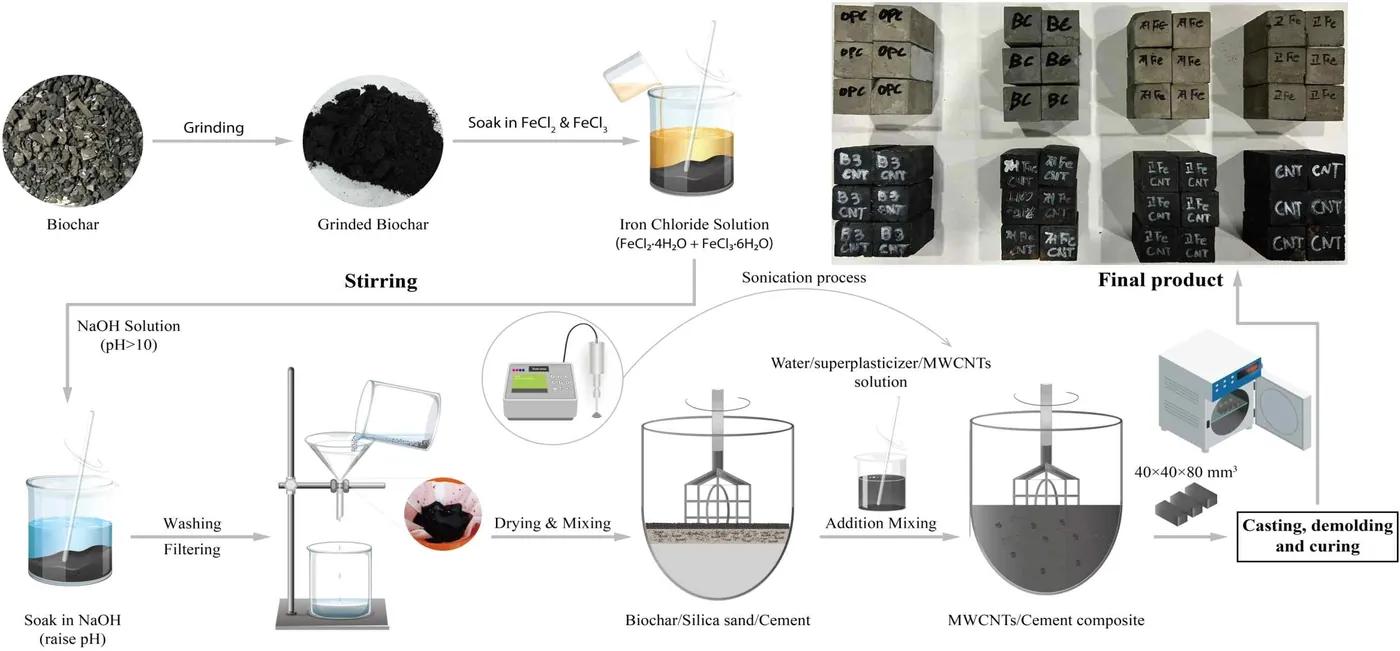
In the lab
Process and testing
-
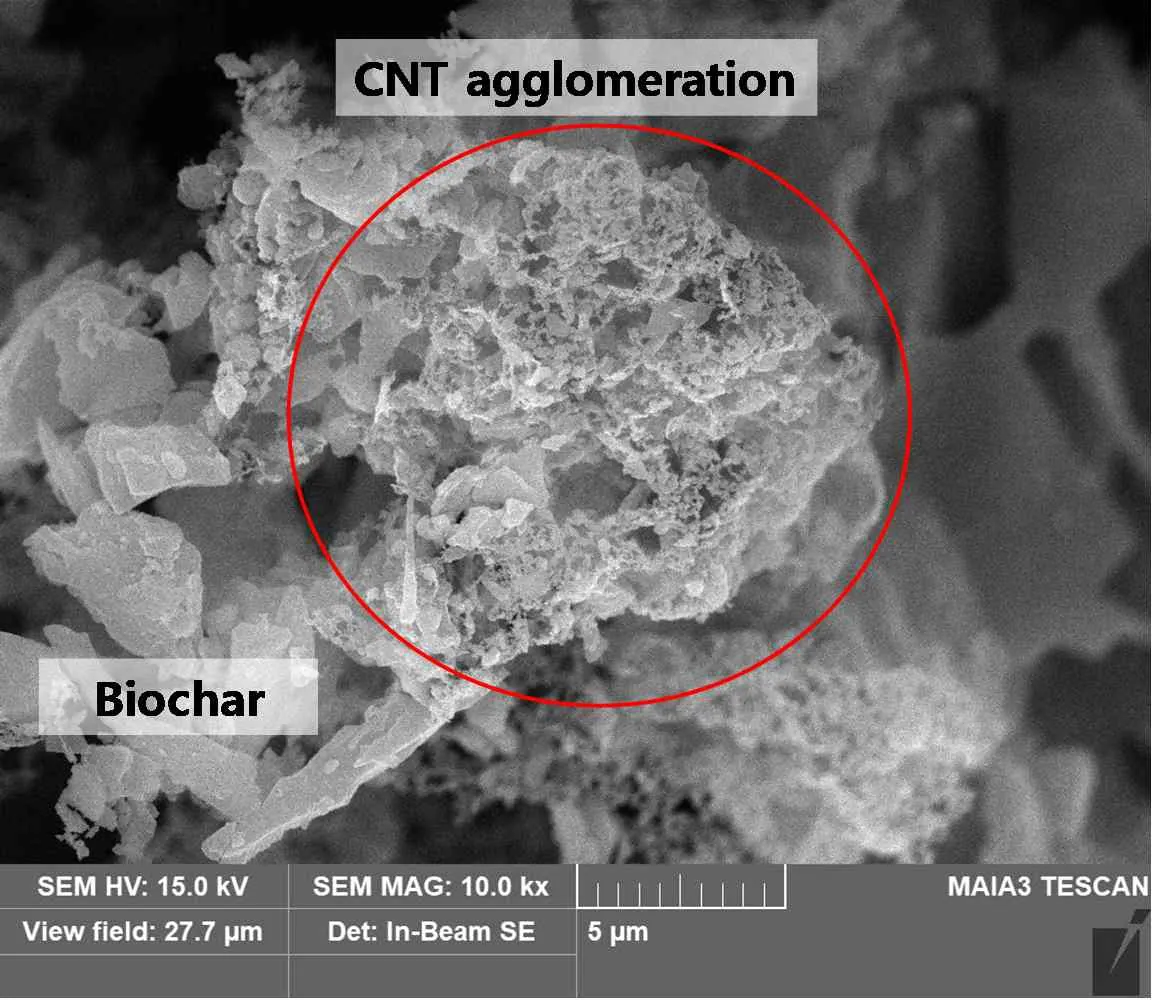
SEM image of CNT grown on the biochar surface -
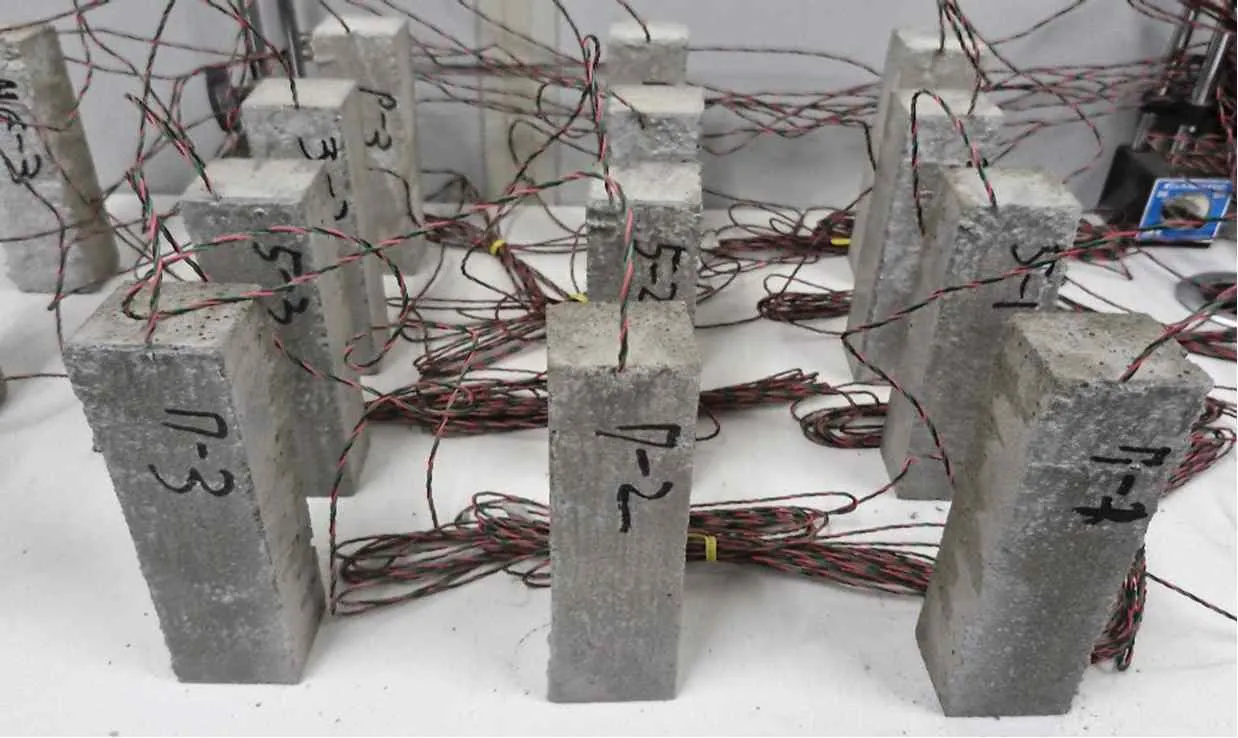
Instrumented cement-composite specimens under testing -
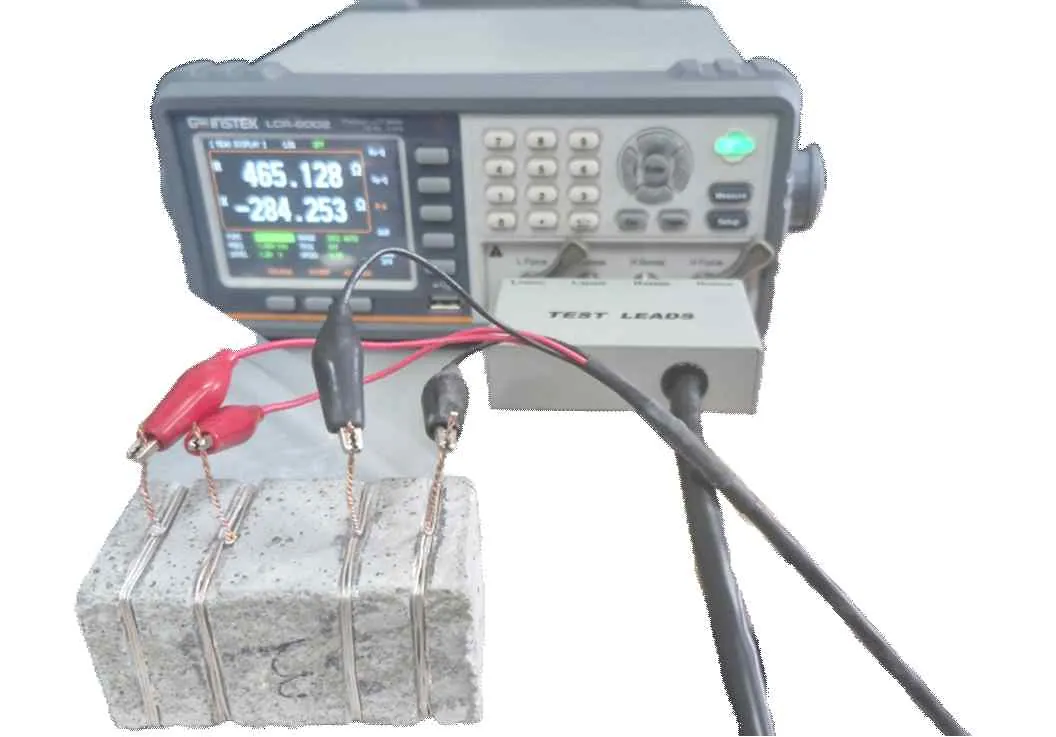
Electrical-resistance (conductivity) measurement of a specimen
Annual plan
Three-year roadmap
- Year 1 Biochar-graphene cement composite development; cement-composite sensor development; structural performance of commercial-biochar RC members.
- Year 2 Conductive-composite durability and performance; improved self/electrical conductivity; RC member performance and rebar-anchorage finite-element model.
- Year 3 Carbon-sequestering RC member structural performance and material model; long-term-sensing-based maintenance and analysis model.
Keywords
Research keywords
- Biochar
- Carbon sequestration
- Cement composite
- Graphene
- Self-sensing
- Conductive performance
- Finite element analysis
- RC member